
Understanding your yearly earnings is an important part of managing money, applying for financial products, completing forms, and planning for the future. What Is Annual Income refers to the total amount of money a person expects to earn over a one-year period before or after certain deductions, depending on the context. It can include wages, salaries, self-employment earnings, bonuses, commissions, and other qualifying sources.
Knowing your annual earnings makes it easier to compare job offers, create realistic budgets, estimate taxes, and measure financial progress. However, annual income can be calculated differently depending on whether you earn an hourly wage, monthly salary, commissions, or irregular payments. This guide explains the meaning, calculation methods, examples, and practical importance of yearly income in clear, straightforward terms.
| Information | Details |
| Meaning | Total income earned or expected over a 12-month period |
| Origin | Financial and employment terminology |
| Gender | Not applicable |
| Pronunciation | Annual income: AN-yoo-uhl IN-kum |
| Religion | Not applicable |
| Lucky Number | Not applicable |
| Lucky Color | Not applicable |
| Lucky Stone | Not applicable |
| Lucky Day | Not applicable |
| Lucky Metal | Not applicable |
| Zodiac Sign | Not applicable |
| Name Length | Not applicable |
| Name Popularity | Common financial term |
| Similar Names | Yearly income, annual earnings, yearly earnings |
What Is Annual Income?

What Is Annual Income can be answered simply: it is the total amount of money an individual receives or expects to receive during a 12-month period. The figure may represent income from employment, self-employment, investments, rental property, commissions, bonuses, or other sources.
For an employee, annual income may be based on a fixed salary or an hourly wage. For someone who works independently, it may depend on business revenue, freelance payments, contracts, and other earnings.
The exact definition can vary depending on why the information is being requested. A lender may calculate income differently from an employer, government agency, or tax authority. Therefore, always check whether a form asks for gross income, net income, taxable income, or another specific figure.
How Is Annual Income Calculated?
The basic calculation depends on how you are paid. If you receive a fixed yearly salary, your annual income may simply equal your stated salary. If you earn an hourly wage, you generally multiply your hourly rate by the number of hours worked and the number of working weeks in a year.
For example:
Hourly rate × hours per week × weeks worked per year = estimated annual income
If you earn $20 per hour, work 40 hours each week, and work 52 weeks, the calculation is:
$20 × 40 × 52 = $41,600
For monthly earnings, multiply your regular monthly amount by 12. If you earn $3,500 each month, your estimated yearly income is $42,000 before considering bonuses, deductions, or irregular earnings.
What Counts as Annual Income?

What counts toward yearly earnings depends on the circumstances and the organization requesting the information. Employment income is usually the most obvious source, but it may not be the only one.
Potential sources can include:
- Wages and salaries
- Overtime pay
- Bonuses
- Commissions
- Tips
- Freelance or contract earnings
- Self-employment income
- Rental income
- Interest income
- Dividends
- Certain pension payments
- Some government benefits
- Other recurring sources of earnings
Not every payment should automatically be included. For example, a reimbursement for a business expense may not be treated the same way as compensation. When completing an official financial application, follow the specific definition provided by that organization.
Gross Income vs. Net Income
Gross income is the amount earned before deductions. Net income is the amount left after applicable deductions have been taken out.
For an employee, deductions can include income taxes, retirement contributions, insurance premiums, and other payroll deductions. As a result, someone with a $60,000 gross salary will generally receive less than $60,000 in take-home pay during the year.
This distinction matters because financial forms may ask for one figure specifically. A lender might evaluate gross income when assessing repayment capacity, while a household budget is often more useful when based on actual take-home pay.
Annual Income vs. Annual Salary
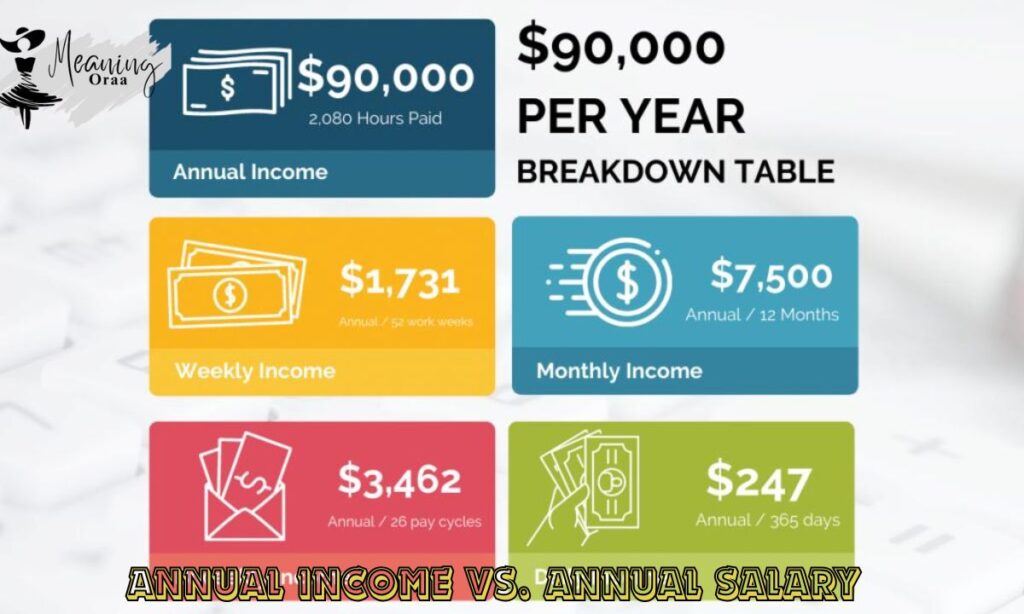
Annual salary is usually a fixed amount an employer agrees to pay an employee over a year. Annual income can be broader because it may include salary plus additional earnings.
For example, someone could have a $50,000 annual salary and receive another $5,000 through bonuses and commissions. Their total yearly earnings could therefore be $55,000 before applicable deductions, depending on how the income is defined.
This difference is particularly important when comparing job offers. One position might offer a higher base salary, while another could provide substantial commissions, overtime, bonuses, or other compensation.
How to Calculate Annual Income From Hourly Pay
If you are paid by the hour, you can estimate your yearly earnings with a simple formula:
Hourly wage × hours worked per week × weeks worked per year
Suppose you earn $18 per hour and work 35 hours each week for 50 weeks:
$18 × 35 × 50 = $31,500
This is an estimate rather than a guarantee. Your actual income may change if you work overtime, take unpaid leave, receive bonuses, or have an irregular schedule.
If your working hours vary significantly, using your actual hours from previous pay periods can provide a more realistic estimate than assuming the same number of hours every week.
How to Calculate Annual Income From Monthly Pay

Monthly pay is straightforward to convert into yearly earnings. Multiply your regular monthly income by 12.
Monthly income × 12 = annual income
For instance, if your monthly pay is $4,000:
$4,000 × 12 = $48,000
If your monthly earnings fluctuate, calculate each month’s actual amount and add them together. This approach is especially useful for freelancers, sales professionals, seasonal workers, and business owners.
Remember that this calculation may represent gross income unless you are specifically working with after-tax or take-home amounts.
Annual Income Examples
Here are several simple examples to show how yearly income can work in different situations.
Example 1: Salaried employee
An employee earns a fixed salary of $72,000 per year. Their annual salary is $72,000, while their take-home amount will be lower after deductions.
Example 2: Hourly employee
A worker earns $22 per hour and works 40 hours a week for 52 weeks:
$22 × 40 × 52 = $45,760
Example 3: Monthly earner
Someone receives $3,200 per month:
$3,200 × 12 = $38,400
Example 4: Multiple income sources
A person earns $45,000 from employment, $6,000 from freelance work, and $3,000 from qualifying investment income. Their total income could be $54,000 before considering the rules applicable to the specific financial or tax situation.
These examples demonstrate why it is important to identify all relevant income sources before calculating a complete yearly figure.
Read More: https://meaningoraa.com/444-tattoo-meaning/
Why Annual Income Matters
Knowing What Is Annual Income and how it is determined can help you make better financial decisions. Employers, lenders, landlords, financial institutions, and government agencies may request yearly income information for different reasons.
For example, lenders can use income information when assessing whether an applicant can reasonably manage loan payments. Landlords may consider earnings when evaluating rental applications. Individuals can use the same information to compare employment opportunities and understand their overall financial position.
It also provides a consistent time frame for comparing different sources of earnings. Instead of looking at one paycheck or one month, you can evaluate income across an entire year.
Annual Income for Budgeting and Financial Planning
Yearly income provides a useful foundation for building a realistic financial plan. Once you know your expected earnings, you can estimate how much may be available for housing, food, transportation, savings, debt payments, and discretionary spending.
For budgeting purposes, it can be helpful to convert annual income into monthly or weekly amounts. However, base your spending plan on take-home pay when possible because gross earnings do not reflect the money actually available after deductions.
Annual income can also help with longer-term goals. You may use it to estimate potential savings, evaluate affordability, prepare for large expenses, and compare your current financial position with future objectives.
Annual Income vs. Annualized Income
Annual income and annualized income sound similar, but they are not always identical. Annual income generally describes the actual or expected amount earned over a full year. Annualized income takes earnings from a shorter period and projects what they would equal over 12 months.
For example, if someone earns $10,000 during three months, annualizing that figure could produce an estimate of $40,000 if the same pace continued for four quarters.
Annualized figures are useful when income is new, seasonal, irregular, or available for only part of a year. However, they are estimates rather than proof that the same earnings will continue. This distinction matters when evaluating financial applications or planning future expenses.
Frequently Asked Questions
1. What is annual income in simple terms?
What Is Annual Income can be understood as the total money a person earns during a 12-month period. Depending on the situation, it may include salary, wages, commissions, bonuses, self-employment earnings, investments, rental income, or other qualifying sources.
2. Is annual income the same as salary?
Not necessarily. Salary usually refers to a fixed amount an employer agrees to pay an employee each year. Annual income can include salary plus additional earnings such as bonuses, commissions, overtime, freelance payments, or other qualifying sources.
3. How do I calculate annual income from hourly pay?
Multiply your hourly rate by the number of hours you normally work each week and then by the number of weeks you work each year. For example, $20 per hour × 40 hours × 52 weeks equals an estimated $41,600.
4. Does annual income mean gross or net income?
It can mean either, depending on the context. Gross income is calculated before deductions, while net income is what remains after taxes and other deductions. Always check the instructions on the financial or employment form to determine which figure is required.
5. Why is annual income important for financial planning?
Annual income helps you understand your overall earning capacity and create realistic financial goals. It can support budgeting, savings planning, debt management, job comparisons, loan applications, and decisions about major expenses.
Conclusion
Understanding What Is Annual Income is essential for making informed decisions about employment, budgeting, borrowing, and long-term financial planning. The figure represents income over a 12-month period, but the calculation can vary depending on whether you earn a salary, hourly wages, monthly payments, commissions, freelance income, or money from several sources.
The most important step is to identify which type of income a particular situation requires. Distinguishing gross from net earnings and actual income from annualized estimates can prevent costly misunderstandings. Once you have an accurate yearly figure, you can use it as a practical foundation for budgeting, comparing opportunities, and building a stronger financial future.

Karina Smith is a passionate writer and language enthusiast who loves exploring words, meanings, and sharing helpful knowledge with readers.