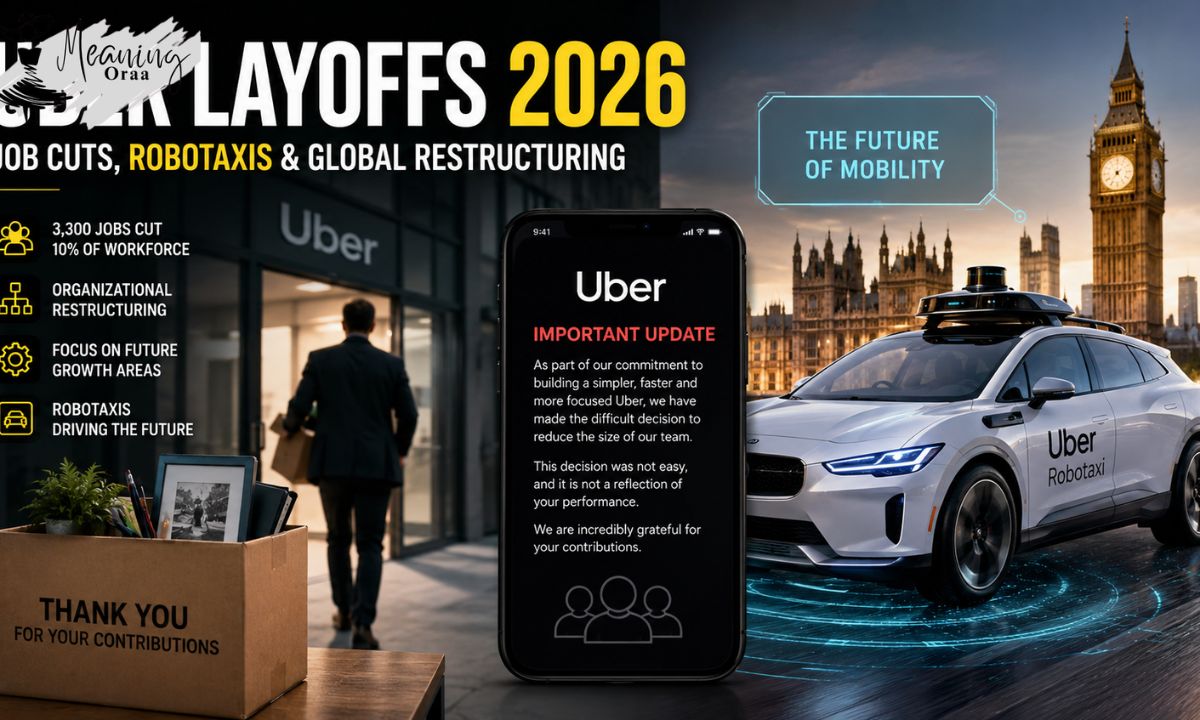
Uber Layoffs in 2026 have put a major shift in the company’s business strategy under the spotlight. Uber has announced a workforce reduction of about 10%, affecting roughly 3,300 corporate roles, while it simplifies management and redirects resources toward growth areas. The move comes even as the company says its core business is performing strongly. It also arrives as autonomous vehicles become a bigger part of the transportation market.
This guide explains the reasons behind the Uber Layoffs, how the restructuring may affect employees and drivers, and why rob taxis matter to Uber’s next phase. You will also learn what is happening in London, where Uber and Waive are preparing autonomous rides, and what the changes could mean for competition, technology, and long term growth. The goal is to separate confirmed developments from assumptions about what comes next.
Uber’s Major Global Layoffs

The 2026 Uber Layoffs represent one of the company’s largest workforce reductions since the pandemic period. Uber says the changes are designed to make the organization simpler, faster, and easier to manage.
About 3,300 corporate employees are affected, equal to roughly 10% of the workforce. The company is also reducing management layers and changing how teams are organized.
Uber has said affected employees were notified, although some countries must follow local employment procedures before the changes can be completed.
The restructuring includes several organizational changes:
- Reducing the number of managers by about 20%.
- Cutting the number of very small “micro-teams.”
- Combining certain engineering, science, and delivery functions.
- Bringing restaurant, retail, and direct delivery operations under unified leadership.
- Concentrating employees in major locations.
- Significantly reducing fully remote work.
Uber reported approximately 34,000 employees at the end of 2025 in its annual filing, showing how significant the new reduction is relative to its recent workforce size.
Why Uber Is Cutting Jobs

The main reason behind the Uber Layoffs is organizational complexity rather than a simple collapse in demand. Uber says years of rapid expansion created more management layers, overlapping responsibilities, and slower decision-making.
Simplifying the Organization
Uber has expanded across ride-hailing, food delivery, retail delivery, advertising, autonomous vehicles, and other mobility services. Growth created larger teams, but it also created additional coordination costs.
The company now wants fewer layers between senior leadership and employees. Some managers will reportedly move into individual contributor positions instead of remaining in management roles.
Redirecting Resources
The company also wants more capacity to invest in future growth. Autonomous vehicles are one of the most important areas because rob taxis could eventually change how ride-hailing platforms operate.
Importantly, Uber has not described artificial intelligence as the direct reason for the 2026 cuts. The stated focus is organizational efficiency and prioritization.
Impact of the Restructuring
The Uber Layoffs will have different effects across the company. Corporate employees face the most immediate impact, while customers, contractors, and business partners may experience more indirect changes.
For employees, the restructuring can create uncertainty around roles, reporting lines, office locations, and career progression. Smaller teams may also have broader responsibilities after departments are combined.
For the business, the potential benefit is faster decision-making. Fewer management layers can make it easier to approve projects and move resources toward products that management considers strategically important.
However, restructuring also creates risks. Uber’s own regulatory filing warns that workforce reductions can lead to employee distraction, lower morale, unwanted attrition, and difficulty recruiting talent later.
| Potential benefit | Potential risk |
| Faster decision-making | Lower employee morale |
| Lower organizational complexity | Loss of experienced workers |
| Clearer team ownership | Short-term disruption |
| More focused investment | Increased workload for remaining staff |
| Leaner management structure | Recruitment challenges |
Uber’s Growing Rob taxi Competition
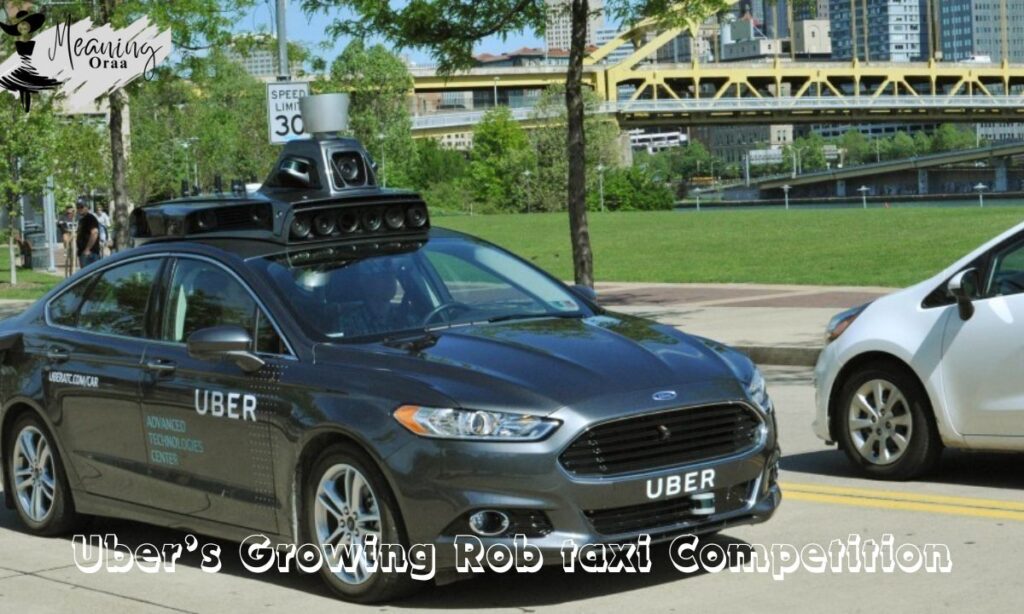
Rob taxis are becoming a major competitive issue for Uber. Companies such as WeMo and Tesla are increasing attention on autonomous transportation, while Uber is building partnerships rather than developing every part of the technology itself.
Uber has partnered with autonomous-driving companies, including Waive in the United Kingdom and Momenta for planned international deployments. Its model is based on combining autonomous vehicle technology with Uber’s existing customer and driver platform.
The competitive advantage could come from distribution. Uber already has a large customer base and a mature app, payment system, marketplace, and logistics network.
The challenge is that rob taxi companies are developing their own technology and customer relationships. Uber therefore needs to prove that its platform can remain valuable even when a human driver is no longer required for every trip.
Driverless Cabs and Uber’s Future
The Uber Layoffs are taking place as autonomous transportation becomes a larger part of the company’s long-term planning. That does not mean Uber is immediately replacing its human driver network with autonomous cars.
Uber’s current strategy is more accurately described as a mixed model. Human drivers and autonomous vehicles can operate through the same marketplace, giving riders different transportation options.
This approach could provide several advantages:
- More vehicle availability during busy periods.
- Potentially lower operating costs for some autonomous trips.
- Better use of Uber’s existing technology platform.
- New opportunities for vehicle and technology partners.
- Greater flexibility as regulations develop.
The biggest uncertainty is timing. Rob taxis still face technical, regulatory, insurance, and public acceptance challenges. A successful long-term model will depend on whether autonomous vehicles can operate safely and economically at scale.
Rob taxis Enter the London Market

London is an important test market for Uber’s autonomous strategy. Uber and Waive have received Private Hire Vehicle licenses for certain autonomous vehicles, creating a path toward paid autonomous rides in the city.
However, the London rollout needs careful interpretation. The first Waive and Uber service is designed to operate with a trained safety driver inside the vehicle. Fully driverless commercial services require additional regulatory approval.
Regulatory uncertainty has already affected the expected timeline. London authorities have been examining the safety, transport, and employment implications of autonomous passenger vehicles.
More than 100,000 Londoners have reportedly joined the interest list for the Uber and Waive autonomous service, showing significant consumer curiosity.
For Uber, London provides a valuable real-world environment to test how customers respond to autonomous rides while the regulatory framework continues to develop.
Read More: https://meaningoraa.com/how-to-get-a-personal-loan-with-a-low-cibil-score/
How the Cuts Affect Uber Drivers
The corporate Uber Layoffs do not represent a direct mass reduction of Uber drivers. Drivers and couriers generally operate as independent contractors rather than corporate employees, so the announced employee cuts are focused on Uber’s internal workforce.
Still, drivers have reasons to watch the company’s autonomous strategy.
If rob taxis become widely available, they could eventually compete with human-driven trips in selected markets. That could affect demand, trip volumes, pricing, or driver utilization over time.
At the same time, autonomous vehicles are unlikely to replace every driver immediately. Regulation, vehicle availability, operating conditions, customer preferences, and geography will all influence adoption.
For drivers, the practical issue is not today’s corporate restructuring. It is how quickly autonomous transportation develops in the markets where they work.
Uber’s Business Strategy Shift
The Uber Layoffs are part of a broader effort to make the company more focused after years of expansion. Management wants teams to have clearer ownership and fewer organizational barriers.
Uber is also trying to balance its established businesses with emerging opportunities. Ride-hailing and delivery remain central, while autonomous vehicles represent a major long-term investment area.
The strategy can be viewed through three priorities:
- Improve efficiency: Remove unnecessary management layers and simplify teams.
- Protect core businesses: Continue improving rides and delivery while facing strong competition.
- Invest for the future: Develop partnerships and capabilities around autonomous mobility.
This balance is important because Uber cannot depend entirely on a future technology whose commercial timeline remains uncertain.
Technology and Automation at Uber
Technology has always been central to Uber’s business model. The company uses software for matching riders and drivers, pricing, navigation, payments, fraud detection, marketplace management, and logistics.
Automation adds another layer. Autonomous vehicles could eventually automate the driving portion of a trip, but Uber’s platform would still have to manage customer requests, payments, routing, vehicle availability, and support.
That means automation does not necessarily make the platform less important. Instead, it could change where Uber creates value.
The Uber Layoffs should therefore not be interpreted as proof that every technology-related role is disappearing. The company is simultaneously trying to direct talent and investment toward areas it believes will support future growth.
Global Market Challenges
Uber operates in a highly competitive and heavily regulated global market. Local transportation laws, labor rules, pricing pressure, competition, and consumer behavior can differ significantly from one country to another.
The company is also facing competition across more than one business line. Ride-hailing competitors challenge its core marketplace, while food and retail delivery businesses face their own rivals.
International expansion can increase revenue opportunities, but it also creates operational complexity. Uber’s 2025 annual filing specifically notes that managing global growth and organizational changes can place pressure on systems, personnel, and financial resources.
For the company, the challenge is finding the right balance between global scale and local flexibility.
What Uber Employees Can Expect
Employees affected by the Uber Layoffs can expect changes not only in employment status but also in how the remaining organization operates. Uber says the restructuring is intended to remove layers, simplify teams, refine its location strategy, and focus investment on major opportunities.
Remaining employees may see:
- New reporting structures.
- Merged teams and responsibilities.
- Greater emphasis on key company hubs.
- Less flexibility for fully remote work.
- More focus on individual contribution in some roles.
- Increased attention on strategic technology and growth projects.
Uber has also indicated that less than 1% of its employees will remain fully remote, while its broader hybrid approach requires regular office attendance.
For employees considering their next steps, understanding the company’s priority areas may be useful. Skills connected to engineering, autonomous mobility, data, operations, product development, and marketplace technology could remain strategically relevant, although no specific role is guaranteed.
What the Layoffs Mean for Uber’s Future
The long-term effect of the Uber Layoffs will depend on whether the company can turn a simpler organization into faster execution and stronger investment.
The immediate goal is efficiency. The bigger strategic question is whether Uber can remain a leading mobility platform as autonomous vehicles become more common.
Uber has an important asset in its marketplace, customer base, technology infrastructure, and global reach. Partnerships with autonomous vehicle companies could allow it to participate in the rob taxi market without having to build every vehicle and driving system itself.
But the future remains uncertain. Autonomous technology still faces regulation, safety, cost, and competition challenges. The strongest outcome for Uber would be a business that combines its existing marketplace strengths with new autonomous transportation options.
The Uber Layoffs therefore represent more than a reduction in headcount. They are part of an attempt to reshape the organization around a changing transportation industry.
Frequently Asked Questions
Why is Uber laying off employees in 2026?
The Uber Layoffs are mainly aimed at simplifying the organization and reducing management layers.
Uber says the goal is faster decision-making and greater focus on future opportunities.
How many jobs is Uber cutting?
Uber announced plans to reduce its workforce by about 10%, affecting roughly 3,300 corporate roles.
The company has described the move as part of a wider organizational restructuring.
Are Uber drivers affected by the layoffs?
The announced Uber Layoffs focus on corporate employees rather than independent drivers and couriers.
Drivers could face longer-term changes if autonomous vehicles expand significantly.
Are Uber rob taxis already operating in London?
Uber and Waive have received licenses for autonomous vehicles, with initial rides involving a trained safety driver.
Fully driverless commercial operation still depends on further regulatory and technical progress.
Will the Uber Layoffs help the company grow?
The restructuring could reduce complexity and free resources for strategic investments.
Its success will depend on whether Uber can execute faster while managing the risks of workforce reductions.
Conclusion
The 2026 Uber Layoffs show how a rapidly growing technology company can reach a point where scale itself creates organizational challenges. Uber is responding by reducing management layers, combining teams, changing workplace expectations, and concentrating resources on its most important businesses. At the same time, the company is preparing for a transportation market where autonomous vehicles could become increasingly important.
For employees and drivers, the changes create both uncertainty and new questions about the future of work. For Uber, the bigger test is strategic execution. If the company can simplify its operations while successfully integrating autonomous mobility with its existing marketplace, the restructuring could strengthen its position. If not, the cuts may create disruption without delivering the expected long-term benefits.

Karina Smith is a passionate writer and language enthusiast who loves exploring words, meanings, and sharing helpful knowledge with readers.