
The VTO Meaning can be confusing because the abbreviation is commonly used for more than one workplace concept. In most business and employment settings, VTO means Voluntary Time Off, a type of unpaid leave that employees may choose to take when their employer offers it. It is often used when a company has fewer work hours available than usual.
VTO can also mean Volunteer Time Off, which is paid or unpaid time employees receive to participate in charitable or community activities. Understanding the context is important because these two meanings have very different purposes. This guide explains both uses of VTO, how they work, how they compare with PTO, and what employers should consider when creating a clear VTO Meaning policy.
Professional Information Table
| Information | Details |
| Name Meaning | VTO commonly means Voluntary Time Off or Volunteer Time Off |
| Origin | Workplace and human-resources terminology |
| Gender | Not applicable; VTO is an acronym |
| Pronunciation | V-T-O (“vee-tee-oh”) |
| Religion | Not applicable |
| Lucky Number | Not applicable |
| Lucky Color | Not applicable |
| Lucky Stone | Not applicable |
| Lucky Day | Not applicable |
| Lucky Metal | Not applicable |
| Zodiac Sign | Not applicable |
| Name Length | 3 letters |
| Name Popularity | Common workplace abbreviation |
| Similar Names | PTO, LOA, unpaid leave, volunteer leave |
What Is Voluntary Time Off (VTO)?

The VTO Meaning most commonly refers to Voluntary Time Off in workplace conversations. It allows employees to voluntarily take time away from work, usually without receiving their normal wages for those hours. Companies may offer VTO when business demand is low, staffing needs change, or there is not enough work available for everyone.
Unlike mandatory unpaid leave, VTO Meaning is generally presented as an optional choice. An employee can decide whether taking time away fits their needs. Depending on company policy, employees may request VTO through a scheduling system, manager, or human resources department.
VTO can benefit both sides. Employees gain flexibility and additional personal time, while employers can adjust staffing levels without forcing workers to remain on the clock when demand is limited.
What Is Volunteer Time Off?
Another important VTO Meaning is Volunteer Time Off, which refers to employer-supported time for charitable, nonprofit, or community service activities. Unlike Voluntary Time Off, this type of VTO is generally designed to encourage employees to contribute to causes outside their normal job responsibilities.
A company may provide a specific number of paid volunteer hours each year. Employees could use those hours to support food banks, environmental projects, educational programs, animal shelters, or other approved organizations.
Volunteer Time Off can become part of a company’s employee benefits and corporate social responsibility strategy. It gives workers an opportunity to contribute to their communities without necessarily having to use their regular vacation or personal leave.
Because the two definitions are different, employees should always check their employer’s policy to determine which type of VTO Meaning is being discussed.
VTO vs. PTO: What’s the Difference?
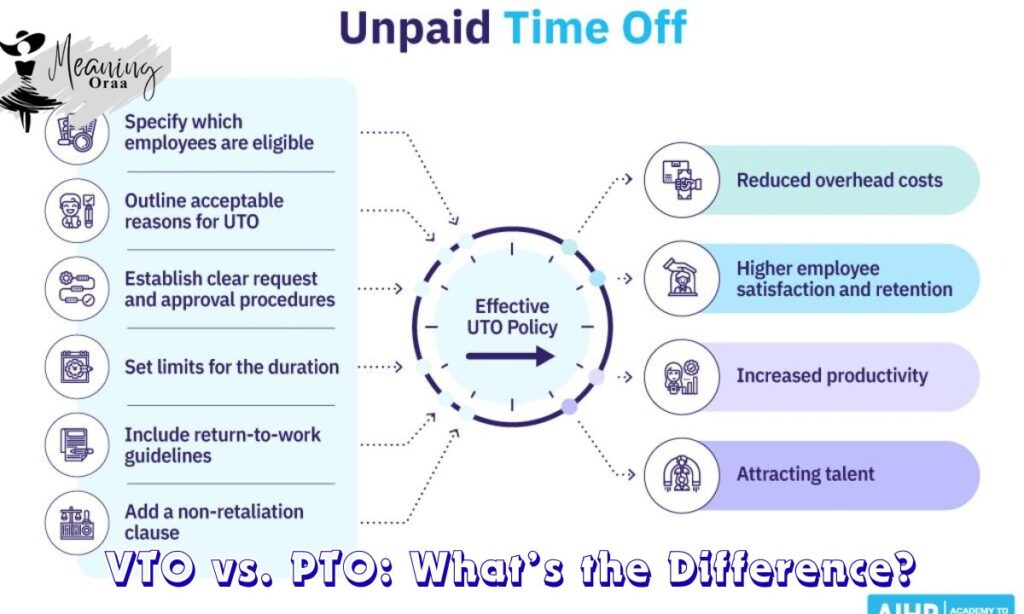
Understanding the VTO Meaning becomes easier when you compare it with PTO, or Paid Time Off. Although both involve time away from work, they are usually offered for different reasons and operate under different rules.
| Feature | VTO | PTO |
| Common meaning | Voluntary Time Off | Paid Time Off |
| Pay | Usually unpaid when referring to Voluntary Time Off | Usually paid |
| Purpose | Often responds to low business demand or scheduling needs | Vacation, personal time, illness, or other approved absences |
| Employee choice | Usually voluntary | Employee generally requests time off |
| Accrual | Typically does not accrue like PTO | Often accrued or granted by the employer |
| Employer control | Often offered based on operational needs | Usually governed by a leave policy |
The biggest difference is compensation. PTO generally provides paid hours away from work, while Voluntary Time Off is commonly unpaid. Volunteer Time Off is different again because it may provide paid hours specifically for community service.
How Does Voluntary Time Off Work?

The VTO Meaning in scheduling and workforce management usually involves employees voluntarily accepting time away from work when an employer makes that option available. The process can differ considerably between companies.
For example, a business may experience a slower-than-expected day and determine that fewer employees are needed. Instead of keeping the full workforce scheduled, management may announce that VTO Meaning is available. Eligible employees can then request or accept the offered hours.
Some organizations use workforce-management software to notify employees about available VTO. Others may rely on supervisors or internal communication systems. Approval can depend on staffing levels, employee eligibility, the timing of the request, and company rules.
Employees should understand whether VTO is paid or unpaid, whether benefits are affected, whether approval is guaranteed, and whether taking VTO affects attendance records. Clear policies prevent misunderstandings.
Benefits of Voluntary Time Off
One major benefit is flexibility. Employees may welcome an opportunity to leave work early or take a scheduled day away when business conditions allow it.
VTO can also help workers manage personal responsibilities without using their valuable PTO balance. Someone who needs additional time for errands, family obligations, appointments, or rest may find the option useful.
For employers, voluntary time off can provide a practical way to control labor costs during periods of reduced demand. It can also reduce unnecessary labor hours while giving employees more control over their schedules.
Drawbacks of Voluntary Time Off
The biggest disadvantage is that Voluntary Time Off is often unpaid. Employees who rely on consistent weekly earnings may find it difficult to accept fewer working hours, even when they appreciate the extra flexibility.
Another concern is availability. VTO Meaning may only be offered when business demand is low, so employees cannot necessarily use it whenever they want. In some workplaces, approval may also depend on staffing requirements.
Workers should therefore consider their financial needs before accepting VTO. Employers should clearly explain the rules so employees understand exactly what they are agreeing to.
Benefits of Volunteer Time Off

Volunteer Time Off can provide meaningful benefits for employees, employers, and communities. Employees get an opportunity to support causes they care about while remaining connected to their workplace.
For workers, volunteering can create a stronger sense of purpose and community involvement. It may also help employees develop communication, leadership, organization, and teamwork skills that can transfer to their professional lives.
Employers can benefit from stronger employee engagement and a more socially responsible workplace culture. A well-designed volunteer program may also improve the company’s reputation among employees, customers, and prospective candidates.
From a community perspective, employer-sponsored volunteering can direct additional time and skills toward nonprofit organizations that need support. This makes Volunteer Time Off more than a simple workplace benefit; it can become part of a company’s broader community impact.
Challenges of Volunteer Time Off
Volunteer Time Off can create administrative challenges when policies are not clearly defined. Employers need to decide which organizations qualify, how many hours employees receive, whether unused hours expire, and whether volunteer activities must be approved in advance.
There can also be scheduling difficulties. If several employees request volunteer leave at the same time, managers may need to balance community involvement with business requirements.
Another challenge is fairness. A policy should apply consistently to eligible employees and avoid creating confusion about which activities qualify. Clear documentation, straightforward approval procedures, and transparent eligibility requirements can make the program easier to manage.
How Many Companies Offer VTO?
There is no single universal percentage that accurately represents how many companies offer VTO because VTO Meaning varies between Voluntary Time Off and Volunteer Time Off, and employers define these programs differently.
Volunteer Time Off is often included in benefits packages offered by organizations that emphasize employee volunteering, community engagement, or corporate social responsibility. Voluntary Time Off, meanwhile, may appear more often in industries where staffing levels change quickly according to customer demand.
Availability can also vary by company size, industry, location, employment status, and workforce structure. A large company may have a formal written policy, while a smaller business may handle time-off arrangements informally.
For employees researching a job opportunity, the best approach is to review the company’s benefits documentation or ask human resources what VTO means within that particular organization. The same abbreviation can represent very different benefits.
How to Create a VTO Policy
Creating a clear policy starts with defining exactly what VTO Meaning represents within the organization. Employers should avoid using the abbreviation without explanation because employees may interpret VTO as either Voluntary Time Off or Volunteer Time Off.
If the policy concerns Voluntary Time Off, employers should explain when VTO may be offered, whether it is paid or unpaid, who qualifies, how employees request it, and whether approval depends on operational requirements.
If the policy covers Volunteer Time Off, employers should define the annual allowance, eligible volunteer activities, approval process, documentation requirements, and whether the time is paid.
A good policy should be written in plain language and easily accessible to employees. Managers should also receive guidance so that the policy is applied consistently across teams.
Key Considerations for VTO Policies
Employers should consider several practical issues before launching a VTO program:
- Eligibility: Clearly state which employees can participate.
- Pay status: Explain whether the time is paid, unpaid, or subject to different rules.
- Approval: Describe who approves requests and how far in advance employees should apply.
- Scheduling: Explain how VTO interacts with staffing requirements.
- Limits: Establish annual, monthly, or event-based limits when appropriate.
- Documentation: State whether employees must provide proof of volunteering.
- Benefits: Clarify whether VTO affects benefit eligibility or accruals.
- Consistency: Apply the policy fairly to eligible employees.
- Legal compliance: Review the policy against applicable employment laws and regulations.
- Communication: Make the rules easy for employees to understand and access.
These details can reduce disputes and help employees make informed decisions before requesting time away from work.
Read More: https://meaningoraa.com/funny-cat-jokes/
VTO Policy Best Practices for Employers
A strong VTO policy should be simple, transparent, and consistent. Employers should define the term clearly at the beginning and distinguish between Voluntary Time Off and Volunteer Time Off whenever both are available.
Managers should also communicate VTO opportunities through reliable channels. Employees should know when VTO is available, how to request it, whether requests are guaranteed, and what happens after approval.
For Volunteer Time Off, employers should establish reasonable guidelines without making the process unnecessarily complicated. Employees should understand which activities qualify and whether volunteer hours must be completed with approved organizations.
Finally, companies should periodically review their policies. Employee feedback, scheduling data, participation rates, and operational results can help employers determine whether the program is meeting its intended purpose. A well-managed policy can provide flexibility while supporting both employee needs and organizational goals.
Frequently Asked Questions
1. What does VTO Meaning stand for?
The VTO Meaning commonly refers to Voluntary Time Off, which usually allows employees to voluntarily take unpaid time away from work. However, VTO can also mean Volunteer Time Off, which gives employees time to participate in approved charitable or community activities.
2. Is VTO paid or unpaid?
When VTO means Voluntary Time Off, it is generally unpaid, although individual employer policies may differ. When VTO means Volunteer Time Off, the hours may be paid as an employee benefit. Always check the company’s official policy before assuming how VTO affects your paycheck.
3. Is VTO the same as PTO?
No. PTO usually means Paid Time Off and provides paid leave for purposes such as vacation, personal needs, or illness. Voluntary Time Off is commonly unpaid and may be offered when an employer has reduced staffing needs. Volunteer Time Off serves a separate community-service purpose.
4. Can an employer require employees to take VTO?
Voluntary Time Off is generally intended to be optional, which is why the word “voluntary” is important. However, workplace rules and employment laws can vary. Employees should review their employer’s written policy and ask HR whether participation is optional or subject to specific conditions.
5. Why do companies offer VTO?
Companies may offer Voluntary Time Off to manage staffing levels and labor costs during periods of reduced demand. Volunteer Time Off has a different purpose: it can encourage community involvement, support employee engagement, and strengthen an organization’s social responsibility efforts.
Conclusion
The VTO Meaning depends heavily on workplace context. Most commonly, it refers to Voluntary Time Off, allowing employees to voluntarily take time away from work, often without pay. In other organizations, VTO means Volunteer Time Off, a benefit designed to support charitable and community activities. Knowing which definition applies is essential before making decisions about your schedule or benefits.
VTO can offer meaningful flexibility for employees and practical advantages for employers when managed properly. A clear policy should explain eligibility, compensation, approval procedures, scheduling, and expectations. Whether VTO is used to manage workforce demand or encourage community service, transparency helps ensure that employees understand the benefit and can use it confidently.

Karina Smith is a passionate writer and language enthusiast who loves exploring words, meanings, and sharing helpful knowledge with readers.