
The Trophy Wife Meaning describes a woman who is perceived as being attractive, stylish, accomplished, or socially impressive and who is married to a man who is viewed as wealthy, powerful, successful, or influential. The phrase is commonly used to suggest that the husband sees his wife partly as a symbol of status or achievement. However, the expression can be much more complicated than its simple dictionary-style definition suggests.
Today, people often question the assumptions behind the term. A woman may have her own career, ambitions, wealth, education, or public reputation rather than simply serving as an accessory to her husband. Understanding the Trophy Wife Meaning requires looking at its history, stereotypes, modern relationships, and the difference between public perception and private reality.
| Information | Details |
| Name Meaning | A woman perceived as a symbol of her partner’s success or social status |
| Origin | Modern English; based on the metaphor of a trophy representing achievement |
| Gender | Traditionally female |
| Pronunciation | TROH-fee wife |
| Religion | Not associated with any religion |
| Lucky Number | N/A — this is a phrase, not a personal name |
| Lucky Color | N/A |
| Lucky Stone | N/A |
| Lucky Day | N/A |
| Lucky Metal | N/A |
| Zodiac Sign | N/A |
| Name Length | 10 letters excluding the space |
| Name Popularity | Commonly recognized English expression, but not a conventional personal name |
| Similar Names | Status Wife, Power Couple, Socialite, Gold Digger |
What Does Trophy Wife Mean?

The Trophy Wife Meaning refers to the idea of a wife whose beauty, youth, elegance, accomplishments, or social appeal is perceived as evidence of her husband’s wealth, influence, or success. The word “trophy” creates an image of something displayed as a prize, which explains the status-related implication of the phrase.
The expression is generally used in a social or cultural context rather than as a formal relationship term. It can be neutral, humorous, admiring, or insulting depending on who says it and why.
For example, someone might describe a successful businessman’s glamorous younger wife as a “trophy wife” because they believe her appearance enhances his public image. That assumption, however, does not necessarily reflect the couple’s actual relationship.
A marriage involving a wealthy or successful man and an attractive woman does not automatically fit the stereotype. Relationships are built on many factors, including affection, shared values, compatibility, friendship, trust, and mutual support.
Trophy Wife Definition and Origin
The Trophy Wife Meaning developed from the comparison between a spouse and a trophy. A trophy represents something earned through achievement, competition, or success. When the expression is applied to marriage, it suggests that a wife is being treated as a visible symbol of her husband’s accomplishments.
The exact origin of the phrase is difficult to reduce to one individual or event, but its widespread use is associated with modern English-language media and discussions about wealth, marriage, beauty, and social status. The expression became especially recognizable through popular culture, entertainment reporting, and commentary about relationships between wealthy older men and younger attractive women.
Importantly, the phrase reflects a social stereotype rather than an objective measurement of a marriage. It tells us more about the assumptions of the person using the term than about the people being described.
That distinction is essential when considering the Trophy Wife Meaning today. A label can simplify a complicated relationship into a single characteristic and overlook the individual identities, achievements, and choices of both partners.
Common Trophy Wife Characteristics
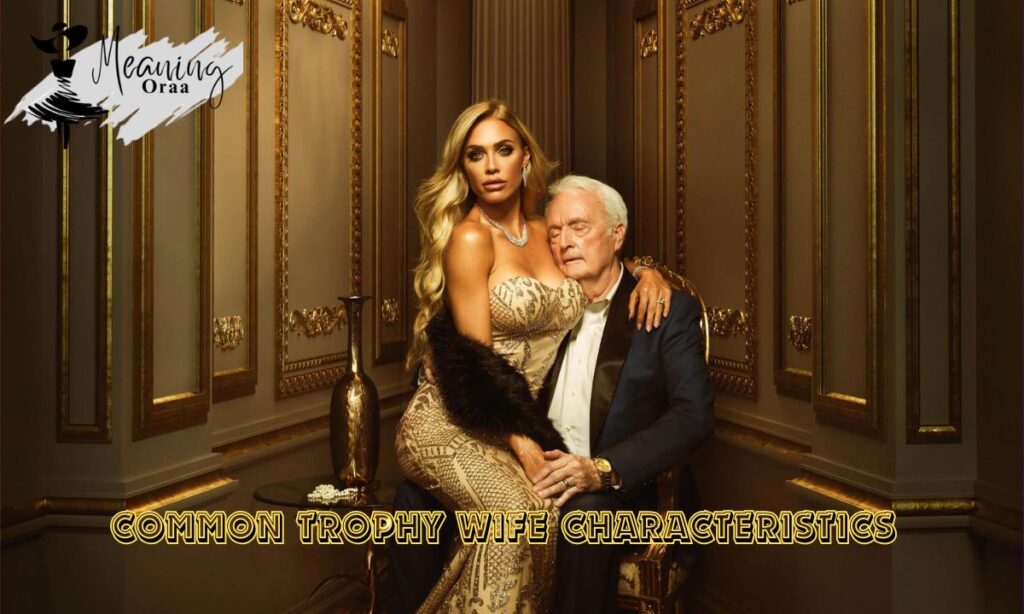
There is no official checklist that makes someone a trophy wife. Instead, popular culture has created a collection of characteristics that are commonly associated with the stereotype.
These may include:
- Physical attractiveness or glamorous appearance
- Youth, particularly in relationships with older partners
- Fashionable or sophisticated personal style
- A connection to wealthy or influential social circles
- Public visibility or celebrity status
- Social confidence and polished presentation
- A spouse who has significant wealth, power, or professional influence
- Participation in luxury-oriented lifestyles
- Strong attention from the media or public
Some women who fit one or more of these characteristics may be described using the phrase, but that does not mean the label is accurate.
A woman can be highly attractive and independently successful without being defined by her husband’s achievements. Likewise, a marriage between people of different ages or financial backgrounds does not automatically indicate that one partner is being used as a status symbol.
Understanding this distinction makes the Trophy Wife Meaning more nuanced and prevents assumptions based solely on appearance, age, or money.
Trophy Wife Examples in Real Life
The concept has frequently appeared in discussions about celebrity relationships, business families, entertainment figures, and wealthy social circles. Public commentators may use the label when a famous or wealthy man marries a woman who is considerably younger, highly attractive, fashionable, or socially prominent.
However, applying the term to a real person can be unfair because outsiders rarely know the complete circumstances of a private relationship. A couple may have shared interests, emotional compatibility, family connections, professional partnerships, or a long history that is invisible to the public.
For this reason, it is better to discuss examples as cultural patterns rather than automatically labeling specific women. The stereotype often appears when people see a noticeable combination of wealth, age differences, beauty, and social status.
The Trophy Wife Meaning becomes particularly controversial when the label is attached to a real woman without evidence that she is valued only for her appearance or status. Public perception and personal reality can be very different.
Trophy Wife Stereotype vs. Reality
One of the biggest problems with the stereotype is that it reduces a woman’s identity to her relationship with a successful man. It may imply that her appearance is her main contribution to the marriage while ignoring education, career achievements, personality, intelligence, business skills, or personal independence.
Reality is usually more complicated.
A woman married to a wealthy or influential man may have her own company, professional career, investments, creative work, charitable activities, or public accomplishments. She may also contribute to the relationship emotionally and practically in ways that outsiders cannot see.
The stereotype can also affect men by suggesting that they deliberately “acquired” a beautiful spouse to demonstrate their wealth. Such assumptions can erase genuine affection and companionship.
Consequently, the Trophy Wife Meaning should be understood as a cultural label rather than a factual description of a person’s motives or relationship.
Modern Trophy Wife Meaning
The Trophy Wife Meaning has changed as ideas about marriage, gender roles, careers, and financial independence have evolved. In earlier popular usage, the expression often portrayed the wife as a beautiful reward for a wealthy or powerful husband. Modern conversations increasingly challenge that one-dimensional idea.
Many women today have independent careers, businesses, investments, education, and personal identities. A woman can be married to a wealthy man while also being financially successful herself. She may even earn more than her spouse or have a stronger public profile.
Social media has further complicated the concept. Luxury lifestyles, designer fashion, travel, and celebrity relationships can create the appearance of status-driven marriages, but online images rarely show the complete story.
Modern interpretations therefore require greater care. The phrase can still describe a recognizable social stereotype, but it should not automatically be used as a factual judgment about a woman’s character, motivations, or relationship.
Trophy Wife vs. Gold Digger

The terms “trophy wife” and “gold digger” are sometimes used interchangeably, but they describe different stereotypes.
A trophy wife is generally associated with appearance, prestige, youth, or social status. A gold digger stereotype, by contrast, focuses primarily on a person’s supposed financial motives for entering or maintaining a relationship.
The difference matters because a woman can be financially independent while still being described as a trophy wife. Similarly, someone may pursue a relationship with a wealthy partner without fitting the appearance-based trophy stereotype.
Key Differences
| Trophy Wife | Gold Digger |
| Focuses on appearance, status, or prestige | Focuses on alleged financial motivation |
| Often associated with a successful or influential spouse | Usually associated with seeking money or material benefits |
| May be financially independent | Stereotype assumes financial dependence or financial motivation |
| Emphasizes public image | Emphasizes perceived monetary gain |
| Can be based largely on appearance or social perception | Based primarily on assumptions about financial intentions |
Neither label should be treated as an objective description without evidence. Both can oversimplify relationships and unfairly judge people’s personal choices.
Read More: https://meaningoraa.com/tres-leches-cake-recipe/
Why Does the Trophy Wife Concept Persist?
The concept persists partly because societies have long connected relationships with status, wealth, beauty, and social power. People often use visible symbols to make assumptions about someone’s success. A glamorous spouse can therefore become part of a public image surrounding wealth and achievement.
Media representation also plays a major role. Movies, television programs, celebrity coverage, magazines, and social media frequently portray wealthy men with beautiful younger partners. Repeated exposure to these patterns can make the stereotype seem familiar or normal.
Gender expectations contribute as well. Traditional social ideas have sometimes presented men as providers and women as symbols of beauty or social prestige. Although modern relationships increasingly reject these roles, cultural stereotypes can survive long after the original social conditions have changed.
The Trophy Wife Meaning therefore remains recognizable because it sits at the intersection of beauty, money, gender expectations, marriage, and social status.
Is Being Called a Trophy Wife an Insult?

Whether the phrase is insulting depends on context, intention, and the person being described. Some people may use it casually or even positively to suggest that a woman is exceptionally attractive and that her partner is successful. Others use it to imply that she lacks independence, intelligence, or meaningful accomplishments.
For many women, being called a trophy wife can feel dismissive because it reduces their identity to appearance and marital status. It can also imply that their relationship is transactional even when there is no evidence for that assumption.
The Trophy Wife Meaning is therefore often viewed critically in modern conversations about gender and relationships. If the phrase is used, context is important. A more respectful approach is to describe the person’s actual achievements, career, personality, or relationship rather than relying on a stereotype.
Related Terms and Similar Concepts
Several expressions overlap with the idea behind Trophy Wife Meaning, although their meanings are not identical.
Status Symbol: A person or object that communicates wealth, success, prestige, or social position.
Power Couple: Two partners who are individually successful or influential and whose relationship creates a strong combined public profile.
Gold Digger: A derogatory term for someone presumed to pursue a romantic relationship primarily for financial benefits.
Socialite: A person who is prominent in fashionable or elite social circles, often through family background, wealth, entertainment, or public visibility.
Arm Candy: An informal expression for an attractive person who accompanies someone publicly and is perceived as enhancing that person’s image.
Power Spouse: A less negative concept describing a partner who is successful, influential, or professionally accomplished in their own right.
These terms demonstrate why language matters. Similar expressions can carry very different assumptions about independence, motivation, wealth, gender, and relationships.
Frequently Asked Questions
1. What is the Trophy Wife Meaning?
The Trophy Wife Meaning describes a stereotype in which a woman is viewed as a symbol of her husband’s wealth, success, or social status, often because of her beauty, youth, elegance, or public appeal. The phrase does not necessarily describe the actual qualities or motivations within a marriage.
2. Is trophy wife a negative term?
It can be negative, depending on how it is used. The expression may imply that a woman is valued mainly for beauty or status and that her marriage is transactional. However, some people use it casually or descriptively without intending an insult.
3. What is the difference between a trophy wife and a gold digger?
A trophy wife stereotype focuses mainly on appearance, prestige, and social status, while a gold digger stereotype focuses on alleged financial motives. The two labels can overlap in casual speech, but they describe different assumptions about relationships.
4. Can an independent woman be called a trophy wife?
Yes. The label is based on public perception rather than a formal definition of financial dependence. An independent woman with her own career, business, wealth, or achievements may still be described this way if people view her as enhancing her partner’s social image.
5. Why is the trophy wife concept controversial?
The concept is controversial because it can reduce women to appearance, age, and marital status while ignoring their accomplishments and individuality. It can also encourage assumptions about relationships based on wealth, beauty, or age differences rather than genuine knowledge of the people involved.
Conclusion
The Trophy Wife Meaning centers on a cultural stereotype in which a woman is perceived as a visible symbol of her partner’s wealth, success, influence, or social standing. While beauty, age, fashion, and status often appear in traditional descriptions, these characteristics do not reveal the true nature of a relationship. Real marriages are far more complex than an outsider’s label can suggest.
Understanding the phrase also means recognizing how language can shape perceptions of women and relationships. A modern perspective should look beyond stereotypes and consider individual achievements, independence, compatibility, and personal choice. The expression remains culturally recognizable, but its meaning is best understood with context, fairness, and an awareness of the assumptions it can carry.

Karina Smith is a passionate writer and language enthusiast who loves exploring words, meanings, and sharing helpful knowledge with readers.