If you have received a message saying “See you TMR” or “I’ll call you TMR,” you may wonder what the abbreviation means. TMR Meaning in Text is simply “tomorrow.” It is a short, informal abbreviation commonly used in texting, chats, comments, and social media conversations. Instead of typing the full word, people shorten it to three letters to save time and keep messages casual.
The abbreviation is especially popular among people who frequently communicate through smartphones and social platforms. It can make everyday conversations quicker without changing the basic meaning of a sentence. However, understanding when to use TMR Meaning is important because it is not suitable for every situation. This guide explains its meaning, slang use, examples, differences from TMRW, and the situations where this abbreviation works best.
TMR Information Table
| Information | Details |
| Meaning | Tomorrow |
| Origin | English texting abbreviation |
| Gender | Not applicable |
| Pronunciation | Tomorrow |
| Religion | Not applicable |
| Lucky Number | Not applicable |
| Lucky Color | Not applicable |
| Lucky Stone | Not applicable |
| Lucky Day | Not applicable |
| Lucky Metal | Not applicable |
| Zodiac Sign | Not applicable |
| Term Length | 3 letters |
| Popularity | Common in informal digital communication |
| Similar Terms | TMRW, 2moro, tomorrow |
What Does TMR Mean in Text?
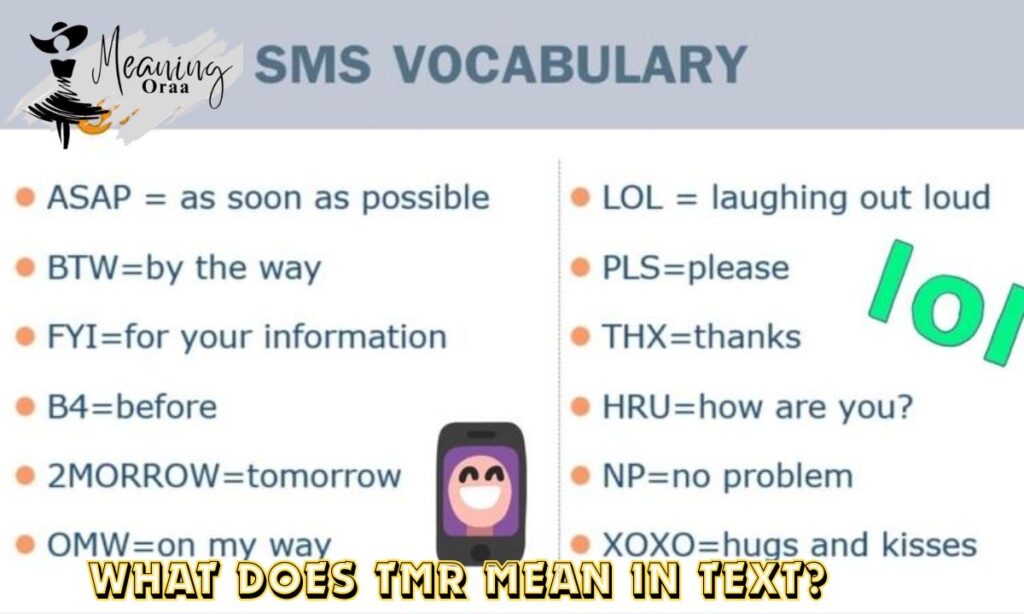
TMR Meaning in Text is “tomorrow.” It is a shortened form of the English word used primarily in casual digital communication. For example, someone might text, “Are you free TMR?” This simply means, “Are you free tomorrow?”
The abbreviation is popular because it removes unnecessary letters while keeping the message easy to understand. Most people recognize TMR immediately when they see it in a text or chat.
Unlike a traditional word, TMR Meaning does not have a separate dictionary meaning in everyday conversation. Its meaning comes from the context in which it appears. It is generally associated with texting, instant messaging, online conversations, and social media.
For example:
- “I’ll send it TMR.”
- “Let’s meet TMR.”
- “Can you finish this TMR?”
- “See you TMR!”
In each sentence, TMR means tomorrow.
TMR Meaning in Slang
In slang and internet language, TMR is a convenient shorthand for “tomorrow.” It belongs to the broader collection of abbreviations people use to communicate quickly online.
The TMR Meaning in Text remains the same when it is used as slang. What changes is the style. Using TMR makes a sentence feel more relaxed and conversational than writing the complete word.
You may see it in messages between friends, group chats, gaming conversations, social media comments, and casual online communities. Its use usually suggests familiarity and an informal setting.
TMR is not offensive, vulgar, or secret slang. It is simply a shortened digital expression. The reader normally does not need special knowledge to understand it.
How Is TMR Used in Messages?
TMR can appear at the beginning, middle, or end of a sentence. Its placement depends on the structure of the message.
For example, “TMR we can discuss it” places the abbreviation at the beginning, while “I’ll finish the project TMR” places it at the end.
Because the abbreviation is so short, it works naturally in quick conversations. Still, the surrounding words should make the intended meaning obvious.
TMR in Texting
Texting is one of the most common places where TMR Meaning appears. People often use it when arranging plans, discussing deadlines, making promises, or talking about upcoming events.
Examples include:
- “What are you doing TMR?”
- “I have an exam TMR.”
- “Let’s talk TMR.”
- “I’ll pay you TMR.”
- “Are we meeting TMR morning?”
The abbreviation works particularly well when the conversation is already casual. Friends, classmates, coworkers who communicate informally, and family members may all use it.
However, you should consider the other person’s communication style. If they prefer complete words or formal messages, writing “tomorrow” may be clearer.
TMR on Social Media
On social media, TMR may appear in captions, comments, direct messages, replies, and posts. Users often prefer short expressions because social platforms encourage fast and informal communication.
Someone might write, “New video coming TMR!” or “Who’s joining us TMR?” Both examples use TMR to refer to the following day.
The abbreviation can also appear alongside other internet shorthand, emojis, hashtags, and casual expressions. Its meaning generally stays straightforward, so readers can understand it without additional context.
TMR Meaning With Examples
Understanding TMR Meaning in Text becomes easier when you see how it works in real conversations. Here are some natural examples:
Example 1:
Person A: “Are you coming to the party TMR?”
Person B: “Yes, I’ll be there!”
Example 2:
Person A: “Can you send me the notes TMR?”
Person B: “Sure, I’ll send them in the morning.”
Example 3:
Person A: “What time should we meet TMR?”
Person B: “Around 5 PM works for me.”
Example 4:
Person A: “I’m busy today, but we can talk TMR.”
Person B: “That’s fine.”
Example 5:
Person A: “The new episode drops TMR!”
Person B: “I can’t wait!”
These examples show that TMR usually replaces the word “tomorrow” without changing the meaning of the sentence.
TMR vs TMRW
TMR and TMRW are both abbreviations for “tomorrow,” but they are not identical in appearance.
TMR Meaning contains three letters and is very compact. TMRW contains four letters and includes the “w” from the end of tomorrow. Both can be understood in casual digital conversations.
For example:
- “See you TMR.”
- “See you TMRW.”
The meaning of both sentences is essentially the same. The choice often comes down to personal preference, typing habits, and the style used by the people in the conversation.
TMR may look slightly shorter and cleaner, while TMRW more clearly resembles the original word. Neither abbreviation is inherently more correct for casual texting.
Why Do People Use TMR?
People use TMR Meaning mainly because it saves time and space. Typing three letters instead of eight can make quick conversations feel easier, particularly when someone is sending several short messages.
Another reason is familiarity. Digital communication has created many abbreviations that are now widely understood. Just as people use “LOL,” “BRB,” or “IDK,” they may use TMR without needing to explain it.
The abbreviation can also make a message sound casual. A sentence such as “Let’s talk TMR” feels natural in a friendly chat.
However, convenience should not override clarity. If there is any chance the reader may misunderstand the abbreviation, using the complete word is the better choice.
Read More: https://meaningoraa.com/steezy-meaning/
When Should You Use TMR?
You can use TMR Meaning when communicating casually with people who are familiar with texting abbreviations. It works well in personal messages, group chats, gaming chats, social media conversations, and informal online communities.
For example, TMR is appropriate when texting a friend about tomorrow’s plans:
“Want to grab lunch TMR?”
It can also work in informal workplace chats when the team commonly uses abbreviations. Still, workplace culture varies, so consider the communication style of your audience.
If you’re communicating with someone for the first time or sending an important message, writing “tomorrow” is often the safer option. Clear communication matters more than saving a few keystrokes.
Is TMR Considered Slang?
TMR can be described as informal texting slang or, more precisely, a digital abbreviation. It is not standard formal English, but it is widely understood in casual online communication.
The TMR Meaning in Text does not change simply because the term is categorized as slang. It continues to mean “tomorrow.”
There is also an important distinction between slang and abbreviations. Slang can involve words or expressions with meanings that differ from standard language, while TMR simply shortens an existing word.
For that reason, some people may call TMR slang, while others may describe it as texting shorthand. Either description communicates the same basic idea: it is informal digital language.
Is TMR Used in Formal Writing?
TMR is generally not recommended for formal writing. Academic papers, business reports, professional applications, official letters, and formal emails should normally use the complete word “tomorrow.”
For example, instead of writing:
“Please send the documents TMR.”
A professional version would be:
“Please send the documents tomorrow.”
Formal writing prioritizes clarity, professionalism, and consistency. Texting abbreviations can make an otherwise professional message appear overly casual.
There are exceptions in highly informal internal communications where abbreviations are accepted by everyone involved. Even then, using the full word is usually a safe choice.
Common TMR Mistakes to Avoid
Although TMR Meaning is simple, a few mistakes can make digital communication less clear.
Using TMR in formal documents:
Avoid it in academic, legal, official, and highly professional writing unless the context specifically allows informal shorthand.
Assuming everyone knows the abbreviation:
Not every reader uses texting slang. If you’re communicating with an unfamiliar audience, “tomorrow” is clearer.
Using it in an unclear sentence:
An abbreviation should never make the meaning difficult to understand. Keep the surrounding sentence straightforward.
Mixing formal and informal styles:
A message can look inconsistent if it combines very formal language with multiple texting abbreviations. Match your style to the audience.
Confusing TMR with unrelated abbreviations:
Context matters. If a conversation could give TMR another meaning, writing “tomorrow” removes possible confusion.
Overall, TMR is best treated as a convenient shortcut for casual communication rather than a replacement for “tomorrow” in every situation.
Frequently Asked Questions
What does TMR mean in text messages?
TMR means “tomorrow” in text messages. It is an informal abbreviation used to make digital conversations shorter and faster. You may see it when people discuss plans, appointments, deadlines, events, or anything happening on the following day.
Is TMR short for tomorrow?
Yes, TMR Meaning is short for tomorrow. The abbreviation removes most of the letters while keeping the meaning easy to recognize. It is commonly used in texting, chats, direct messages, comments, and other casual digital conversations.
What is the difference between TMR and TMRW?
Both TMR and TMRW generally mean “tomorrow.” TMR is shorter, while TMRW contains four letters and more closely represents the spelling of the original word. The choice between them is usually a matter of personal texting preference.
Can I use TMR in a professional email?
You can use TMR in a professional email only if the communication is highly informal and the abbreviation is accepted by your workplace. In most professional situations, writing “tomorrow” is better because it sounds clearer and more polished.
Is TMR slang or an abbreviation?
TMR is commonly described as texting slang or an internet abbreviation. More precisely, it is shorthand for the word “tomorrow.” It does not have a hidden or offensive meaning and is generally used simply to make casual digital communication quicker.
Conclusion
The TMR Meaning in Text is simple: it means “tomorrow.” This three-letter abbreviation has become a familiar part of casual digital communication because it saves time and fits naturally into texts, chats, social media posts, and direct messages. Its meaning remains straightforward, whether it appears at the beginning or end of a sentence.
TMR Meaning is useful when the conversation is informal and the reader understands texting shorthand. However, it is better to write “tomorrow” in academic, official, and professional communication. Knowing when to use the abbreviation is just as important as knowing what it means, making TMR a small but useful part of modern online language.

Karina Smith is a passionate writer and language enthusiast who loves exploring words, meanings, and sharing helpful knowledge with readers.