Learning advanced vocabulary is an important part of improving English skills. Difficult English Words with Meaning can help IELTS students improve their vocabulary range, understand complex texts, and express ideas more clearly in Writing and Speaking tests.
Many learners find difficult words challenging because of spelling, pronunciation, or unfamiliar meanings. However, learning new words with examples and synonyms makes them easier to remember and use correctly.
This guide includes 90 difficult English words with meaning, synonyms and examples for IELTS. You will also learn why some words feel difficult, how to use advanced vocabulary naturally, and the best ways to improve your IELTS vocabulary.
What Makes English Words Difficult to Learn?
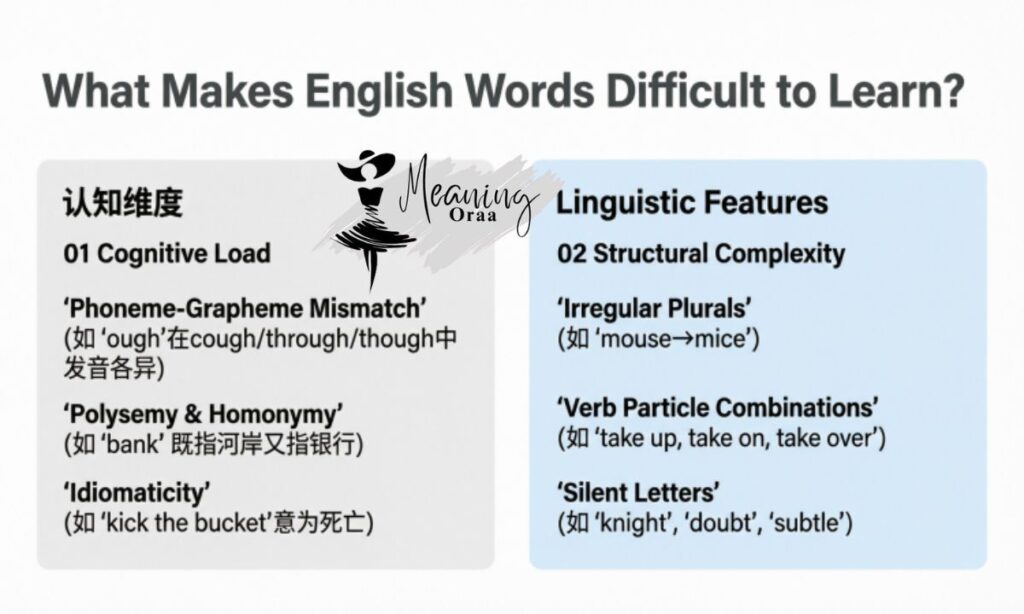
English has thousands of words, but some words feel harder because they are less common or have complex meanings. A word can be difficult because of its spelling, pronunciation, or because it has different meanings depending on the situation.
Learning Difficult English Words with Meaning becomes easier when you understand the context and practice using them in sentences.
Why Some English Words Feel Hard
Some words feel difficult because learners do not see them often in daily conversations. For example, words like “unprecedented” or “ambiguous” may look complicated at first, but regular practice makes them easier.
Common reasons words feel difficult:
- Rare usage in daily life
- Long spelling patterns
- Unusual pronunciation
- Complex meanings
- Similar words with different uses
Meaning, Spelling and Pronunciation Challenges
A difficult English word is not always difficult because of its meaning. Sometimes spelling and pronunciation create problems.
For IELTS learners, it is important to learn:
- Correct meaning
- Proper pronunciation
- Example sentences
- Common usage
This helps you use vocabulary naturally instead of memorizing random words.
90 Difficult English Words with Meaning, Synonyms and Examples for IELTS
| Word | Meaning | Synonym | Example |
| Abrogate | Officially cancel something | abolish | The government decided to abrogate the old law. |
| Anachronism | Something from the wrong time period | outdated thing | The old machine was an anachronism. |
| Ambiguous | Having more than one meaning | unclear | His answer was ambiguous. |
| Abundant | More than enough | plentiful | The country has abundant natural resources. |
| Alleviate | Reduce pain or difficulty | ease | Exercise can alleviate stress. |
| Authentic | Real or genuine | original | She gave an authentic opinion. |
| Benevolent | Kind and generous | charitable | The benevolent person helped many people. |
| Belligerent | Aggressive or hostile | violent | The customer became belligerent. |
| Candid | Honest and direct | truthful | She gave a candid response. |
| Coherent | Clear and logical | understandable | His argument was coherent. |
| Compelling | Very convincing | persuasive | The speaker gave a compelling reason. |
| Conspicuous | Easy to notice | obvious | His mistake was conspicuous. |
| Controversial | Causing disagreement | debatable | The topic is controversial. |
| Deteriorate | Become worse | decline | Air quality continues to deteriorate. |
| Diligent | Hardworking | dedicated | She is a diligent student. |
| Diminish | Become smaller | reduce | The effect will diminish over time. |
| Elaborate | Explain in detail | explain | Please elaborate on your idea. |
| Empathy | Understanding feelings | compassion | Empathy is important in relationships. |
| Enhance | Improve something | increase | Technology can enhance learning. |
| Equivocate | Avoid giving a clear answer | evade | The politician tried to equivocate. |
| Feasible | Possible to do | practical | This plan is feasible. |
| Fundamental | Basic and important | essential | Education is fundamental for success. |
| Garrulous | Talking too much | talkative | My neighbour is very garrulous. |
| Hostile | Unfriendly | aggressive | The environment became hostile. |
| Hypothesis | An idea to test | theory | Scientists tested the hypothesis. |
| Iconoclast | Person who challenges traditions | rebel | He was an iconoclast in his field. |
| Impede | Block progress | prevent | Traffic can impede development. |
| Inevitable | Certain to happen | unavoidable | Change is inevitable. |
| Innovative | New and creative | original | The company created an innovative product. |
| Intricate | Very detailed and complex | complicated | The design is intricate. |
| Justify | Give a reason | explain | He justified his decision. |
| Magnificent | Extremely beautiful | impressive | The view was magnificent. |
| Meticulous | Very careful | precise | She is meticulous at work. |
| Negligible | Too small to matter | insignificant | The difference is negligible. |
| Obsolete | No longer useful | outdated | Many old devices are obsolete. |
| Paradigm | A typical example or model | pattern | The internet changed the paradigm. |
| Perceive | Understand or notice | recognize | People perceive situations differently. |
| Persistent | Continuing strongly | determined | He remained persistent. |
| Plausible | Seeming reasonable | believable | His explanation was plausible. |
| Profound | Very deep or important | meaningful | The book had a profound impact. |
| Reluctant | Unwilling | hesitant | She was reluctant to leave. |
| Resilient | Able to recover quickly | strong | Children are often resilient. |
| Significant | Important | major | The change was significant. |
| Sustainable | Able to continue long-term | lasting | We need sustainable solutions. |
| Transparent | Clear and honest | open | The company needs transparent policies. |
| Tremendous | Very large | enormous | He made tremendous progress. |
| Unique | One of a kind | special | Every culture is unique. |
| Validate | Confirm something | approve | The research validates the theory. |
| Versatile | Having many uses | flexible | English is a versatile language. |
Hard English Words with Synonyms and Examples
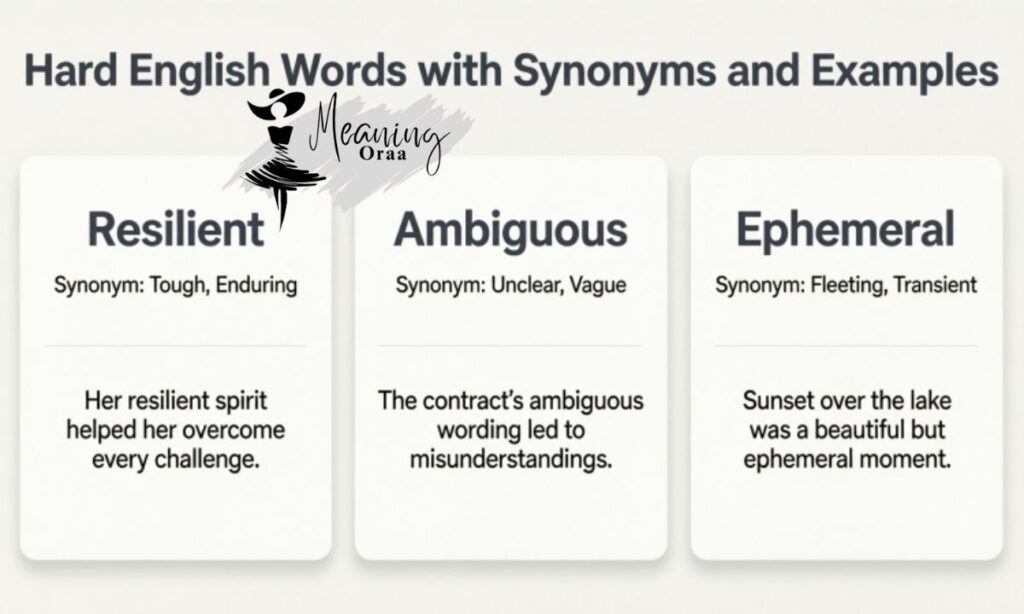
Some advanced words are useful for IELTS because they help you explain ideas clearly.
Examples:
Difficult word: Deteriorate
Meaning: Become worse
Synonym: Decline
IELTS Example: Environmental conditions may deteriorate without proper action.
Difficult word: Significant
Meaning: Important
Synonym: Major
IELTS Example: Education plays a significant role in society.
Difficult Vocabulary Words A-Z
Building vocabulary from A-Z is a simple way to remember new words.
Examples:
A – Abundant, Authentic, Ambiguous
B – Benevolent, Belligerent
C – Coherent, Compelling
D – Deteriorate, Diligent
E – Enhance, Equivocate
F – Feasible, Fundamental
Read More About This: https://meaningoraa.com/1010-angel-number-meaning-in-love/
Commonly Mispronounced English Words
Some English words are difficult because spelling and pronunciation are different.
| Word | Pronunciation |
| Colonel | Ker-nel |
| Worcestershire | Wuss-ter-sheer |
| Rural | Roo-rul |
| Anemone | Uh-nem-uh-nee |
| Onomatopoeia | On-uh-mat-uh-pee-uh |
Clear pronunciation is more important than using extremely difficult words in IELTS Speaking.
Can Difficult Vocabulary Improve IELTS Scores?
Using Difficult English Words with Meaning can improve your IELTS score when the words are used correctly.
IELTS does not reward students for using rare words incorrectly. Examiners focus on:
- Accurate vocabulary
- Natural usage
- Clear communication
- Correct grammar
Using one advanced word correctly is better than using many complicated words incorrectly.
How to Learn Difficult English Words Faster
Learning vocabulary requires regular practice. Try these methods:
Learn Words Through Context
Do not only memorize meanings. Read articles, watch videos, and learn how words are used in real sentences.
Example:
Instead of learning:
“Sustainable = lasting”
Learn:
“Sustainable energy can protect the environment.”
Practice Words with Examples
Create your own sentences using new words. This improves memory and confidence.
Avoid Common Vocabulary Mistakes
Common mistakes include:
- Using words without knowing their meaning
- Wrong pronunciation
- Incorrect spelling
- Using advanced words in the wrong situation
Using Difficult Words in IELTS Writing and Speaking
In IELTS Writing, advanced vocabulary can improve your score if it fits the topic.
Example:
Basic:
“Technology is changing our lives.”
Advanced:
“Technology has significantly transformed modern lifestyles.”
In IELTS Speaking, use words that feel natural. Avoid forcing uncommon vocabulary into conversations.
The best way to master Difficult English Words with Meaning is through practice, examples, and regular revision.
Conclusion
Improving vocabulary takes time and consistency. Learning 90 Difficult English Words with Meaning, Synonyms and Examples for IELTS can help students express ideas better and prepare for IELTS challenges.
Focus on understanding words, practicing them in sentences, and using them naturally. A strong vocabulary is not about knowing the hardest words; it is about using the right words with confidence.

Karina Smith is a passionate writer and language enthusiast who loves exploring words, meanings, and sharing helpful knowledge with readers.